Foreign income and the foreign income tax offset (FITO) in Australia
15 June 2026 · Metrifly team · Updated 21 June 2026
Hold US or other overseas shares and you’ll meet two things at tax time: tax withheld overseas, and the foreign income tax offset (FITO) that stops you being taxed twice on the same income.
This is general information, not tax advice. Check your own situation with a registered tax agent or the ATO.
You’re taxed on worldwide income
As an Australian tax resident, you declare your worldwide income — including dividends from US shares, distributions from global ETFs, and interest from overseas. It’s converted to Australian dollars and added to your return, the same as domestic income. Temporary residents and non-residents are treated differently.
Withholding tax, and double taxation
Many countries tax a dividend before it leaves. The most common case for Australian investors is the US 15% withholding on dividends — the rate under the Australia–US tax treaty, provided you’ve lodged a W-8BEN with your broker. Skip the W-8BEN and the default rate jumps to 30%, and only 15% of that is creditable.
Without relief you’d be taxed twice — once overseas, once in Australia. The foreign income tax offset fixes that: the foreign tax you paid becomes a credit against your Australian tax on that income.
A worked example
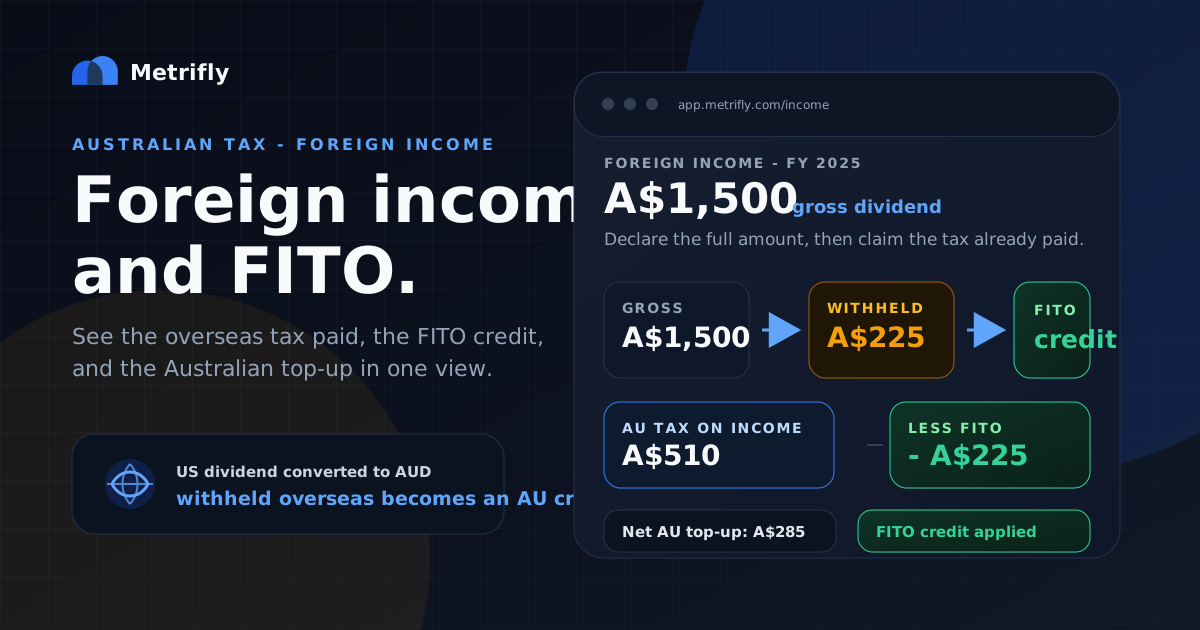
Say you receive a US$1,000 dividend, the AUD/USD rate makes that A$1,500, and the US withholds 15%:
You declare the full A$1,500 (the gross, before withholding) as assessable income. Your Australian tax on that income is then reduced by the A$225 of US tax you already paid. If your marginal rate is above 15% you top up the difference; if it’s below, the offset is capped at your Australian tax on that income — the FITO never refunds foreign tax beyond what Australia would have charged.
The $1,000 FITO limit
If your total foreign income tax offset for the year is $1,000 or less, you can claim the actual foreign tax you paid without the formal limit calculation. Most investors with a modest overseas allocation fall under this cap and simply claim what was withheld.
Claim more than $1,000 and you must work through the formal FITO limit calculation: you compare your tax with the foreign income included against a hypothetical return with the foreign income (and related deductions) removed. The difference is the cap on your offset. Any foreign tax above the cap isn’t refunded and can’t be carried forward.
ETF distributions and AMIT statements
Global and Australian-domiciled ETFs that hold offshore assets pass foreign income and foreign tax paid through to you on an AMIT member annual statement (AMMA). Those statements break out the foreign income and the attached foreign tax offset — the figures flow into your return the same way as a directly held US dividend. Don’t double-count: if foreign tax is reported on an AMMA, it’s already part of your FITO total.
If you’re not sure which AMMA lines affect income versus cost base, see our help guide to understanding AMMA / AMIT statements.
Currency matters too
Foreign holdings add a second moving part: the Australian dollar. A US position can rise in USD but fall in AUD, or vice versa. Two consequences:
- Income and disposals are converted to AUD at the relevant exchange rate — the rate on the date of the dividend or the trade, not today’s rate.
- Part of your return is currency, not the asset. Separating the FX component from the market move tells you what actually drove your result.
CGT on overseas shares
The capital gains rules are the same as for Australian shares: a disposal is a CGT event, and individuals and trusts who held for more than 12 months get the 50% discount — see capital gains tax on shares. The gain is calculated in AUD, so exchange-rate movement between buy and sell affects it. A position can show a USD loss but an AUD gain purely from currency — and it’s the AUD figure the ATO assesses.
Records to keep
- Dividend statements showing the gross amount and foreign tax withheld.
- The AUD conversion used for each dividend and trade, with the rate and date.
- AMMA statements for ETFs and managed funds.
- Buy and sell contract notes for the CGT cost base.
FAQ
Is the foreign income tax offset the same as a franking credit? No. Franking credits relate to Australian company tax on domestic dividends; the FITO relates to foreign tax paid on overseas income. You can have both in the same return.
Do I need to do the FITO limit calculation? Only if your total offset exceeds $1,000 for the year. At or below $1,000, claim the actual foreign tax paid.
What if I didn’t lodge a W-8BEN? US withholding defaults to 30%, but only 15% is generally creditable under the treaty — you may lose the rest. Lodge the W-8BEN with your broker to bring it to 15%.
Tracking foreign income
Tracking this by hand across currencies, withholding and FX is tedious. Metrifly’s US-shares and foreign-income handling converts foreign income to AUD, tracks withholding for your FITO, separates FX gain from market gain, and rolls it into your tax reports. For EOFY prep, see the EOFY checklist, and estimate a single sale with the CGT calculator.