Capital gains tax on shares in Australia: how CGT works
15 June 2026 · Metrifly team
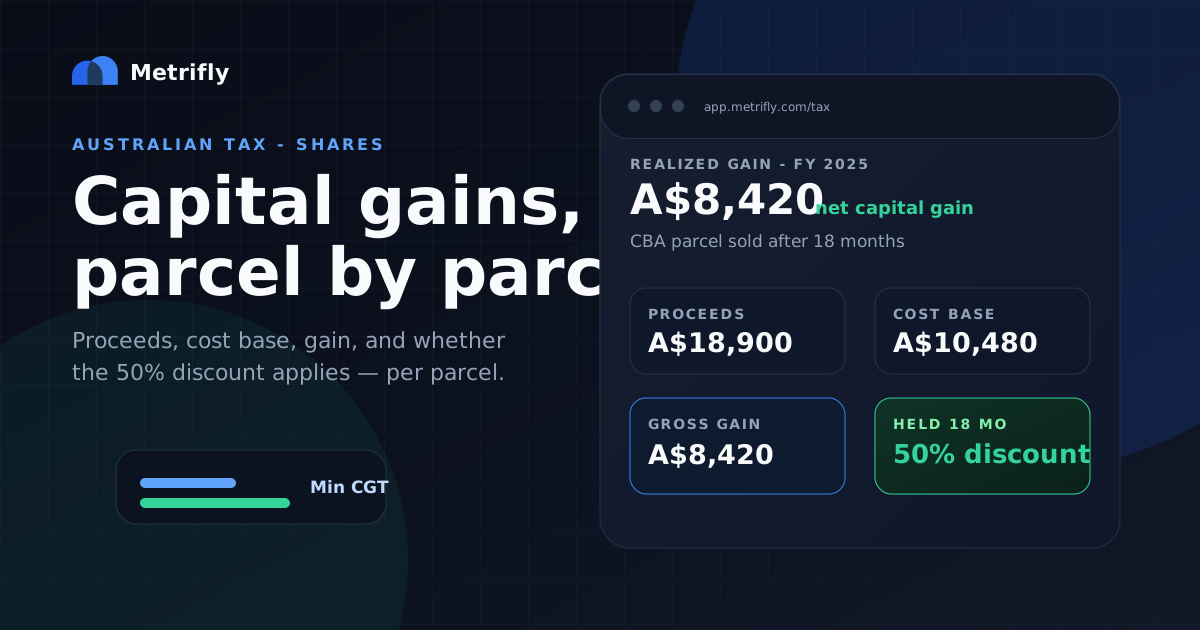
Sell shares for more than you paid and you’ve made a capital gain — and the ATO wants its share. But how much you actually pay depends on how long you held the shares, your other gains and losses, and your tax rate. This guide walks through how capital gains tax (CGT) on shares works in Australia, with a worked example.
This is general information, not tax advice. Check your own situation with a registered tax agent or the ATO.
What triggers capital gains tax?
CGT isn’t a separate tax — a net capital gain is added to your income and taxed at your marginal rate. It’s triggered by a CGT event, and for shares the most common one is a disposal: selling them. But a few things people don’t expect are also disposals:
- Selling shares for cash.
- Gifting or transferring shares to someone else.
- Share-for-share swaps in some takeovers and mergers.
If you simply hold shares and their price rises, there’s no CGT — gains are only taxed when you dispose of the asset (an unrealised gain becomes a realised one at sale).
How a capital gain is calculated
The basic formula is:
capital gain = sale proceeds − cost base
Your cost base is more than just the purchase price. It includes the brokerage on both the buy and the sell, and certain other costs. Including brokerage matters — it lowers your gain and therefore your tax.
For ETFs and managed funds, your cost base can also move after year end through AMIT cost-base increases or decreases on an AMMA statement. If you hold ETFs, reconcile those adjustments before selling; our help guide explains how AMMA / AMIT statements work.
If the result is negative, you have a capital loss (more on those below).
The 50% CGT discount
If you’re an individual or a trust and you held the shares for more than 12 months before selling, you only pay tax on half the capital gain.
| Entity | CGT discount |
|---|---|
| Individuals and trusts | 50% |
| SMSFs (super funds) | 33⅓% |
| Companies | None |
The 12-month clock runs from the day after you bought to the day of the CGT event. Held for exactly 12 months or less? No discount — the whole gain is taxable. Timing a sale around the 12-month mark can change your tax bill.
A worked example
Say you bought $10,000 of shares (including brokerage) and sold them 14 months later for $18,000:
| Step | Amount |
|---|---|
| Sale proceeds | $18,000 |
| Cost base | $10,000 |
| Capital gain | $8,000 |
| Held > 12 months? | Yes → 50% discount |
| 50% discount | −$4,000 |
| Taxable capital gain | $4,000 |
That $4,000 is added to your taxable income. At a 32% marginal rate (including the Medicare levy) the tax is about $1,280 — versus roughly $2,560 if you’d sold before the 12-month mark and missed the discount.
You can run your own numbers with our free capital gains tax calculator.
Capital losses, and the order that matters
A capital loss isn’t deductible against your salary or other income — but it offsets capital gains. Two rules trip people up:
- Apply losses before the discount. You subtract capital losses from your gross capital gain first, then apply the 50% discount to what’s left. Applying the discount first would understate the benefit of the loss.
- Carry losses forward. If your losses exceed your gains this year, the unused amount carries forward indefinitely to offset future gains. Losses never get the discount.
So if you had the $8,000 gain above and a $3,000 capital loss, you’d net to $5,000, then apply the 50% discount → $2,500 taxable.
Which parcels are you selling?
If you bought the same share in several lots and sell only some, which parcels you sell changes the gain. Common approaches:
- FIFO (first-in, first-out) — the default many people assume.
- Minimise gain — sell the highest-cost parcels first to reduce this year’s tax.
- Specific parcels — nominate exactly which to sell.
Choosing the right parcels (and tracking each one’s cost base and acquisition date) can reduce a CGT bill — but it’s fiddly to do by hand across years of trades and DRPs.
How to work it out
- One sale: use the CGT calculator to see the gain, the discount, and the estimated tax.
- Your whole portfolio: Metrifly’s tax reporting tracks every parcel’s cost base and holding period, applies the discount and your entity’s rate, lets you choose the sale-allocation method, and produces a capital gains report with myTax labels.
For the income side of your return — dividends and their credits — see our guide to franking credits, and the EOFY checklist when tax time comes around.
Summary
Capital gains tax on shares comes down to a few moving parts: a CGT event (usually a sale), proceeds minus a cost base that includes brokerage, the 50% discount if you’re an individual or trust who held for more than 12 months, and capital losses applied before the discount. Get the holding period and parcel selection right and the difference to your tax bill can be large.